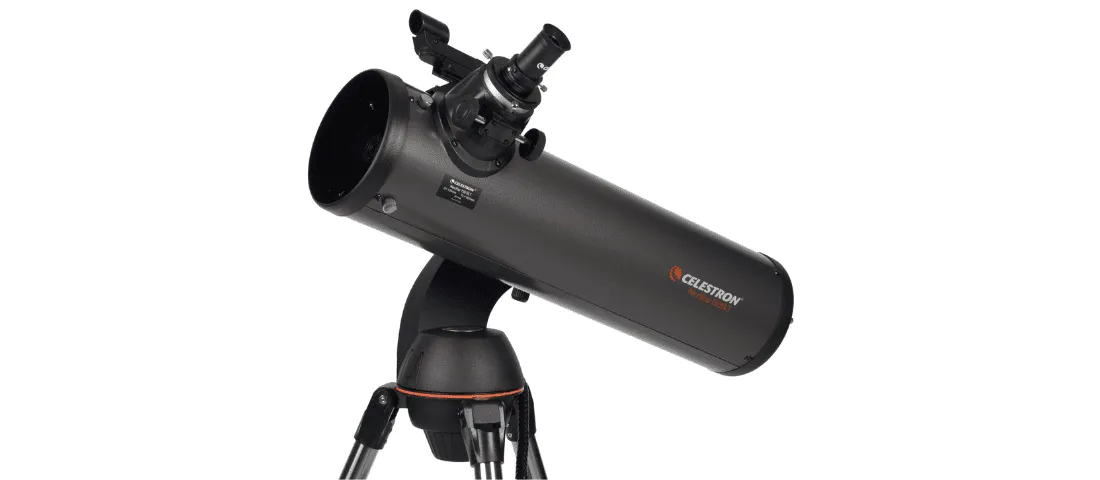
My name’s Adam Kirk and I’ve been an astronomer for 40 years. I’ve run Love the Night Sky since 2013 and, every autumn, the question I’m asked more than any other is which telescope to buy for a child.
It’s harder to answer than it should be, because most of what’s sold as a telescope for kids is really a toy. You’ll know the ones: a galaxy printed on the box, a magnification figure in the hundreds, and a price that looks too good to turn down.
Those are the telescopes that get unwrapped at Christmas and abandoned by February. That’s rarely the child losing interest. It’s usually the telescope being unable to show them anything worth looking at.
In the table below you’ll find our seven best telescopes for kids, grouped by age, and I’d be happy to hand any of them to a child myself. Detailed reviews of all seven are immediately underneath it. After that, I’ve explained what actually matters when you’re buying for a child, what you can realistically expect them to see, and the questions parents ask me most.
If you just want the short version: for most children of eight and over, buy the Sky-Watcher Heritage 130 at around $300. It gathers enough light to show them something they’ll remember, it sets up on a garden table in under a minute, and there’s nothing to align or plug in. For a younger child, or if you’re not sure the interest will stick, the Orion FunScope 76 at under $70 is the least you can spend and still be buying a real telescope.
I earn a commission if you buy through my links. It costs you nothing extra, the price you pay is exactly the same either way, and it never changes which telescopes make this page or the order they appear in. Prices move around, so treat the figures in the table as a guide and the shop’s own page as the last word.
The seven picks compared
| Telescope | Type | Aperture | Focal length | Mount | Typical price | Buy |
|---|---|---|---|---|---|---|
 Best overallSky-Watcher Heritage 130 Tabletop Dobsonian | Newtonian reflector | 130mm (5.1") | 650mm | Tabletop Dobsonian | $305.00 | Check price |
 Best first telescope, ages 4 to 7Orion FunScope 76mm Reflector | Newtonian reflector | 76mm (3") | 300mm | Tabletop alt-azimuth | $59.95 | Check price |
 Best under $100Orion StarBlast 90mm AZ Travel Refractor | Refractor | 90mm (3.5") | 500mm | Alt-azimuth with tripod | $99.95 | Check price |
 Best for a child who is hookedOrion StarBlast 4.5″ Astro Dobsonian | Newtonian reflector | 114mm (4.5") | 450mm | Tabletop Dobsonian | $219.95 | Check price |
 Best for finding things on their ownCelestron StarSense Explorer 114mm Tabletop Dobsonian | Newtonian reflector | 114mm (4.5") | 450mm | Tabletop Dobsonian, phone assisted | $339.99 | Check price |
 Best for learning a proper mountOrion SpaceProbe 130ST EQ Reflector | Newtonian reflector | 130mm (5.1 inch) | 650mm | German equatorial | $329.95 | Check price |
 Best to keep into adulthoodApertura AD6 6-inch Dobsonian | Newtonian reflector | 152mm (6") | 1200mm | Dobsonian | $499.95 | Check price |
Why most children’s telescopes disappoint
Search for a telescope for a child and you will be shown a wall of brightly boxed instruments at thirty to eighty pounds or dollars, often promising magnifications of 300x, 525x or even 675x. Almost all of them share the same three faults, and all three are fatal in the same way.
The magnification claim is the giveaway. What a telescope shows you is set by how much light it collects, which is a question of aperture, the width of the main lens or mirror. Magnification is just a matter of which eyepiece you screw in, and you can magnify a poor image as much as you like. It stays a poor image, only bigger and dimmer. A useful rule is that a telescope can take about twice its aperture in millimetres as its highest useful magnification. A 60mm toy claiming 525x is therefore claiming roughly four times what its own optics can deliver. Push it that far and the child sees a grey smudge.
The mount is usually worse than the optics. This is the part nobody photographs for the box. A telescope on a thin aluminium tripod shakes for several seconds every time a child touches the focuser, and at high magnification the shake is magnified along with everything else. The practical result is that the child cannot hold the Moon still long enough to look at it properly. More first telescopes are abandoned for this reason than for any optical fault.
Most have no usable finder. A telescope shows a very small piece of sky, and pointing one at a specific object without a finder is genuinely difficult, even for an adult who knows the sky. A child who cannot find anything will conclude the telescope is broken, or that they are bad at it. Neither is true, and both end the hobby.
None of this means you have to spend a fortune. It means the money is better spent on aperture and a steady mount than on a long list of accessories and a big number on the box. Every telescope on this page is a real instrument rather than a toy, and the cheapest is under $70.
What actually matters when you are buying for a child
Aperture, within reason. More aperture shows more, and the difference between a 76mm and a 130mm telescope is obvious to a child at the eyepiece. But aperture brings weight and bulk, and a telescope that is awkward to carry outside gets used once a month instead of once a week. For children the right answer is almost always the largest aperture that still feels easy, not the largest aperture you can afford.
A mount that stays still, and one they can carry. Four of the seven picks here are tabletop Dobsonians, and that is deliberate. A tabletop sits on its own base and swings by hand. There are no legs to level, no counterweight to balance and no polar alignment to get wrong in the dark. The whole telescope lives on a shelf indoors, and a child can pick it up and carry it outside on their own.
A tripod scope, next to that, is a production. Legs, head, balancing, and a wobble to wait out every time anyone touches the focuser. That matters far more than it sounds. What hooks a child is a quick, startling view in the first few minutes, and half an hour spent fighting a shaky tripod in the cold does the exact opposite. Get them onto the Moon inside two minutes and you have an astronomer.
The trade is that you have to supply the table, and a four-legged garden table rocks on uneven ground. A low wall, a sturdy bench or an upturned crate is often steadier than the table you had in mind.
Where it will live. A telescope kept in a cold garage behind the bikes is a telescope that never comes out. Tabletop models solve this neatly because they store on a shelf or in a cupboard and set up on a garden table, a wall or a wheelie bin lid. It is a smaller consideration than aperture on paper and a bigger one in practice.
Whether they can find things without you. This is the one genuine advance of the last few years. Phone-assisted telescopes such as the StarSense Explorer models use the phone’s camera to work out where the telescope is pointing and then steer the child to a target with an arrow on screen. For an eight year old who wants to look at Saturn tonight and does not want to wait for a parent to be free, it changes the experience completely.
Best telescopes for ages 4 to 7
At this age the telescope is not really the point. What you are buying is a handful of vivid evenings: the Moon looking like a world rather than a light, Jupiter with its moons in a line, perhaps Saturn’s rings if the year is kind. The child will not operate it alone and does not need to. Buy something light, cheap, and robust enough to survive being knocked off a garden table, and expect to do the pointing yourself.
Do not spend much here. A child of five cannot tell a $60 telescope from a $500 one, and the odds of the interest lasting are honestly not high. The Orion FunScope 76 is the pick. If it is out of stock, the Celestron FirstScope 76 does much the same job for a little more, though it has a cruder focuser and no finder at all.
Best telescopes for ages 8 to 11
This is the age where a telescope can genuinely take hold, and where buying a toy does the most damage. An eight year old can learn to use a Dobsonian properly, can read a star chart with help, and will notice the difference between a sharp view and a poor one. They will also want to go out and look at something without asking permission or waiting for an adult, which argues for a telescope that lives indoors and carries easily.
If you buy one telescope for a child in this band, make it the Sky-Watcher Heritage 130. If the budget is nearer $100 the Orion StarBlast 90mm AZ is the sensible choice, and if the child is already asking to find things on their own, the Celestron StarSense Explorer 114 earns its extra cost.
Best telescopes for ages 12 and up
By twelve a child who is interested is really a beginner astronomer rather than a child with a telescope, and should be bought for on that basis. The question changes from “will this survive them” to “will they outgrow this in a year”. Aperture starts to matter more than portability, because they can carry more and will want to see fainter things: galaxies, nebulae, the moons of Saturn rather than just its rings.
The Apertura AD6 is the pick, and it is the only telescope on this page a teenager can still be using happily in their thirties. If they are more interested in the equipment than the aperture, the Orion SpaceProbe 130ST EQ puts the same 130mm of optics on a German equatorial mount, and learning to drive that teaches how the sky really moves in a way no app does. If they are not quite there yet, the Orion StarBlast 4.5 is a serious instrument at half the price that will not embarrass itself.
The seven picks reviewed
Sky-Watcher Heritage 130: best overall

Aperture
130mm (5.1 inch)
Focal length
650mm, f/5
Mount
Tabletop Dobsonian
Weight
About 14lb
This is the telescope I’d buy for a child of eight or nine without thinking twice about it. 130mm of aperture is a real step up from the small reflectors below it. The Moon is crowded with detail, Jupiter shows its cloud belts rather than just a bright disc, Saturn’s rings are unmistakably rings, and on a dark night the brighter nebulae and clusters are genuinely worth looking at rather than just technically visible.
It matters just as much that it’s easy. It sits on a garden table or a low wall, swings by hand, and needs nothing set up. The tube collapses down for storage, which is what keeps it in the house rather than the garage. The trade is that an open tube lets stray light and dew in more readily than a closed one, so it wants a dark corner of the garden rather than a spot under a security light.
Who it isn’t for: a child under about seven, who’ll struggle to aim it, and anyone who wants something that works straight out of a car boot on holiday.
Pros (3)
- Most aperture for the money here
- Ready to use in under a minute
- Collapses down to store indoors
Cons (2)
- Needs a table or wall to stand on
- Open tube attracts dew and stray light
Orion FunScope 76: best first telescope, ages 4 to 7

Aperture
76mm (3 inch)
Focal length
300mm, f/3.9
Mount
Tabletop alt-azimuth
Weight
4lb
This is the cheapest telescope on the page and the only one I’d describe as suitable for a four year old. It’s a real reflector rather than a toy. 76mm gathers around sixteen times more light than your eye does, which is plenty for a proper look at the Moon, for Jupiter’s four bright moons as points of light, and for the Pleiades filling the eyepiece. It weighs four pounds, so a small child can carry it themselves, and there’s very little on it to break.
Be clear about the limits. The short 300mm focal length gives wide, low-power views, so Saturn will be a small oval with something obviously attached rather than a picture-book ringed planet. The eyepieces are basic. You’ll be doing the aiming for the first year or two. None of that is a criticism at this price, it’s simply what the money buys, and what it buys here is genuinely good.
Who it isn’t for: an eight year old, who’ll outgrow it inside a year and is better served by the Heritage 130 or the StarBlast 4.5.
Pros (3)
- A real telescope at toy money
- Light enough for a small child to carry
- Almost nothing on it to break
Cons (2)
- Basic supplied eyepieces
- Too small for an older child
Orion StarBlast 90mm AZ: best under $100

Aperture
90mm (3.5 inch)
Focal length
500mm, f/5.6
Mount
Alt-azimuth tripod
Weight
8.8lb
The only refractor here, and it earns its place on convenience rather than raw performance. A refractor needs no collimation, which means nothing inside it ever needs realigning, and it’s closed at the front so it stays cleaner and cools faster. On a full-height tripod a child can stand and look rather than crouching over a table, which suits taller children and awkward gardens.
90mm is less aperture than the Heritage 130 and it shows, particularly on anything fainter than the planets. What you gain is that it packs into a car and sets up anywhere, which makes it the best of these for holidays and for families who’ll do most of their observing away from home. The tripod is the weak point, as it is at this price on every brand, so keep the magnification moderate and let it settle after each nudge.
Who it isn’t for: a child whose main interest is deep sky. Aperture wins that argument and a Dobsonian gives more of it per pound.
Pros (3)
- Nothing to collimate, ever
- Packs into a car for holidays
- Child can stand rather than crouch
Cons (2)
- Tripod wobbles at higher magnification
- Least aperture of the reflectors here
Orion StarBlast 4.5: best for a child who is hooked

Aperture
114mm (4.5 inch)
Focal length
450mm, f/3.9
Mount
Tabletop Dobsonian
Weight
10lb
The StarBlast 4.5 has been recommended to beginners for twenty years, and the reason is that it’s very hard to have a bad night with one. 114mm at a fast f/3.9 gives bright, wide views, and that combination is what makes sweeping along the Milky Way rewarding rather than frustrating. It weighs ten pounds complete, so a nine year old can carry the whole telescope outside in one trip without help, and that single fact drives how often it actually gets used.
Against the Heritage 130 it has less aperture and a shorter focal length, so it’s the weaker planetary performer of the two and the better one for star fields and clusters. Between them it’s a real choice rather than a ranking. Pick this one if the child is younger or will be carrying it alone, and the Heritage if planets are the draw.
Who it isn’t for: anyone who wants high magnification on the planets as the main event.
Pros (3)
- Bright, wide views that reward sweeping
- Carried outside in one trip by a child
- Long track record with beginners
Cons (2)
- Not the best on planets
- Still needs a table
Celestron StarSense Explorer 114: best for finding things on their own

Aperture
114mm (4.5 inch)
Focal length
450mm, f/4
Mount
Tabletop Dobsonian, phone assisted
Weight
12.6lb
Optically this is close to the StarBlast 4.5, and on that basis alone the extra cost would be hard to justify. What you’re paying for is the dock and the app. You clip a phone on top, the app reads the star field through the camera, works out exactly where the telescope is pointing, and then shows arrows telling the child which way to push. When the target is centred the display turns green.
For an adult who already knows the sky that’s a convenience. For a child it’s the difference between using the telescope and not using it, because it removes the one step that defeats most beginners. If your child is the sort who wants to go out after homework and find Andromeda without a lesson first, this is the one on this page that lets them.
Two honest caveats. It needs a phone, which for a younger child means it needs your phone, and that partly defeats the object. And it teaches them to follow an arrow rather than to learn the sky, which some parents will count as a feature and some as a loss.
Pros (3)
- App removes the step that defeats beginners
- Same easy tabletop mount
- Proper f/4 optics, not a compromise design
Cons (2)
- Needs a phone, often the parent’s
- Teaches the arrow, not the sky
Orion SpaceProbe 130ST EQ: best for learning a proper mount

Aperture
130mm (5.1 inch)
Focal length
650mm, f/5
Mount
German equatorial
Weight
24.2lb
Everything else on this page is chosen to remove obstacles between a child and the sky. This one deliberately puts one back, and for the right child that’s the point. A German equatorial mount has to be set up facing north and tilted to your latitude, and once it is, a single slow-motion knob tracks a star across the sky as the Earth turns. Learning why that works teaches more real astronomy than any app does.
The telescope on top is a good one: a 130mm parabolic mirror at f/5, the same aperture as the Heritage 130 but on a mount that will follow a planet at high magnification instead of drifting off it. It’s the natural next step for a twelve or thirteen year old who has outgrown pushing a Dobsonian around and wants to understand the equipment rather than just use it.
Be realistic about who this suits. It’s 24lb with the mount, there’s a counterweight to balance, the mirror needs collimating occasionally, and the first night will be spent learning the mount rather than looking at anything. A child who just wants to see Saturn tonight will be happier with the Heritage 130.
Pros (3)
- Teaches how a mount and the sky actually work
- Tracks a planet instead of drifting off it
- 130mm parabolic optics at f/5
Cons (3)
- Setup to learn before the first real view
- Counterweight, balancing and collimation
- 24lb, so not a carry-it-yourself scope
Apertura AD6: best to keep into adulthood

Aperture
152mm (6 inch)
Focal length
1200mm, f/7.9
Mount
Dobsonian
Weight
42.9lb in two parts
Everything else here is a telescope for a child. This is a telescope, which happens to suit a teenager. Six inches of aperture at f/7.9 is the classic all-rounder: enough focal length for sharp, high-power views of the planets and the lunar terminator, and enough light grasp to put hundreds of galaxies and clusters within reach from a reasonably dark garden. Nobody outgrows one of these in a hurry.
It also arrives complete, which is where the Apertura line earns its money. A two inch dual-speed Crayford focuser, two eyepieces, a laser collimator, a moon filter and a finder are all in the box, and buying that list separately costs most of the difference between this and a bare six inch Dobsonian. The one thing to be honest about is the size. It goes outside in two trips, an 18lb tube and a 25lb base, and it isn’t something a twelve year old will carry up and down stairs every night. If your garden is through a narrow hallway, think about that before you think about the aperture.
Pros (3)
- Aperture a teenager won’t outgrow
- Arrives with the accessories you’d otherwise buy
- Sharp on planets and deep sky alike
Cons (2)
- Two trips to carry it outside
- Needs somewhere convenient to store it
Can you see the planets with a children’s telescope?
Yes, and the planets are the best thing to show a child first, because they are bright enough to work from a city garden and they look like something.
Here’s what to expect, honestly.
The Moon is spectacular in anything on this page, and it’s the single most reliable way to impress a child at the eyepiece. Look along the terminator, the line between light and dark, where the shadows are long and the craters stand up.
Jupiter shows as a small bright disc with up to four moons strung out beside it. Those moons visibly change position from one night to the next, which children usually find more interesting than the planet itself. Two dark cloud belts appear in 90mm and upwards.
Saturn shows its rings in every telescope here, including the FunScope, though at 300mm focal length they read as an odd shape rather than a clean gap. From 114mm and up they are unmistakable.
Mars is a small orange disc that only shows surface markings near opposition, and only in the larger scopes. Venus shows phases like a tiny moon, and no detail at all, ever.
What no telescope at any price will show is a photograph. The images on the box and in magazines are long exposures taken with cameras, not what the eye sees. Setting that expectation with a child before the first night out is the most useful thing a parent can do, and it is the difference between delight and disappointment at the eyepiece. If you want to know which planets are actually visible tonight, our guide to the planets this month is updated every month.
Common questions
What is the best starter telescope for a child?
For most children aged eight and over, a tabletop Dobsonian of 114mm or 130mm. It gives the most aperture per pound or dollar, there is nothing to set up, and it stores indoors. The Sky-Watcher Heritage 130 at around $300 and the Orion StarBlast 4.5 at about $220 are the two to choose between. Below eight, spend far less and buy the Orion FunScope 76 at under $70.
Are telescopes good for children?
A good one is, and a bad one is actively counterproductive. A telescope that shakes, cannot be aimed and shows a grey blur teaches a child that astronomy is disappointing. That is the main risk in this purchase, and it is a risk of buying the wrong telescope rather than of buying a telescope. A pair of 10×50 binoculars, incidentally, outperforms every toy telescope sold and costs less than most of them.
What age should a child get their first telescope?
There is no wrong age with an adult alongside, and children as young as four enjoy looking at the Moon. If you mean the age at which a child can use a telescope independently and get real value from it, that is around eight for a simple Dobsonian, or a little younger with a phone-assisted model.
How much should I spend on a telescope for a child?
Under about $50 there is nothing worth buying, and binoculars are the better purchase. Between $60 and $100 you can buy a real, if limited, telescope. Between $200 and $350 you can buy something a child will use for years. Above $500 you are buying for a committed teenager rather than for a child, and should read it as an adult purchase.
Do they need to learn the sky first?
No, but it helps enormously, and it costs nothing. Start with the Moon and whichever planets are up, then learn two or three constellations and use them to find things. Our what’s in the sky tonight page shows what is visible from your location right now, which is the easiest place for a child to begin.
Where to go next
If you are buying for yourself as well, or for an adult beginner, the sizes and priorities change and our guide to the best telescopes for beginners covers those. If you have bought one of these and want somewhere to start on the first clear night, the Moon and Jupiter are the two targets that have never yet let a child down.